TechnipFMC · Python tool
PipeMatch
A tool that turns laser measurements of pipe ends into the best alignment for welding, and checks tolerances across whole batches of pipes.
Why the fit matters
Before two pipe sections are welded together, their ends have to line up. No pipe end is perfectly round, and the wall varies slightly around the circumference. When two ends meet, the walls are offset from each other. This offset is called hi-lo. It is checked at both the inner wall (ID) and the outer wall (OD), and it has to stay within a limit for the weld to be accepted.
The offset depends on how the two pipes are rotated relative to each other. A pairing that fails at one angle can pass comfortably at another. Finding that angle by hand, for every joint in a batch, is slow and hard to trace afterwards.
What PipeMatch does
At TechnipFMC, I developed PipeMatch, a Python tool that takes laser measurements of pipe ends and finds the best alignment between them before welding. It automates the tolerance checks across whole batches of pipes and replaces manual review with traceable results. The tool has been adopted by international engineering teams.
The screenshots below are from an interactive demo of PipeMatch built for this portfolio. All measurements in the demo are synthetic. The sample fleet has 12 pipe bodies with two ends each, each end measured at 360 positions, one per degree.
Two ends, every angle
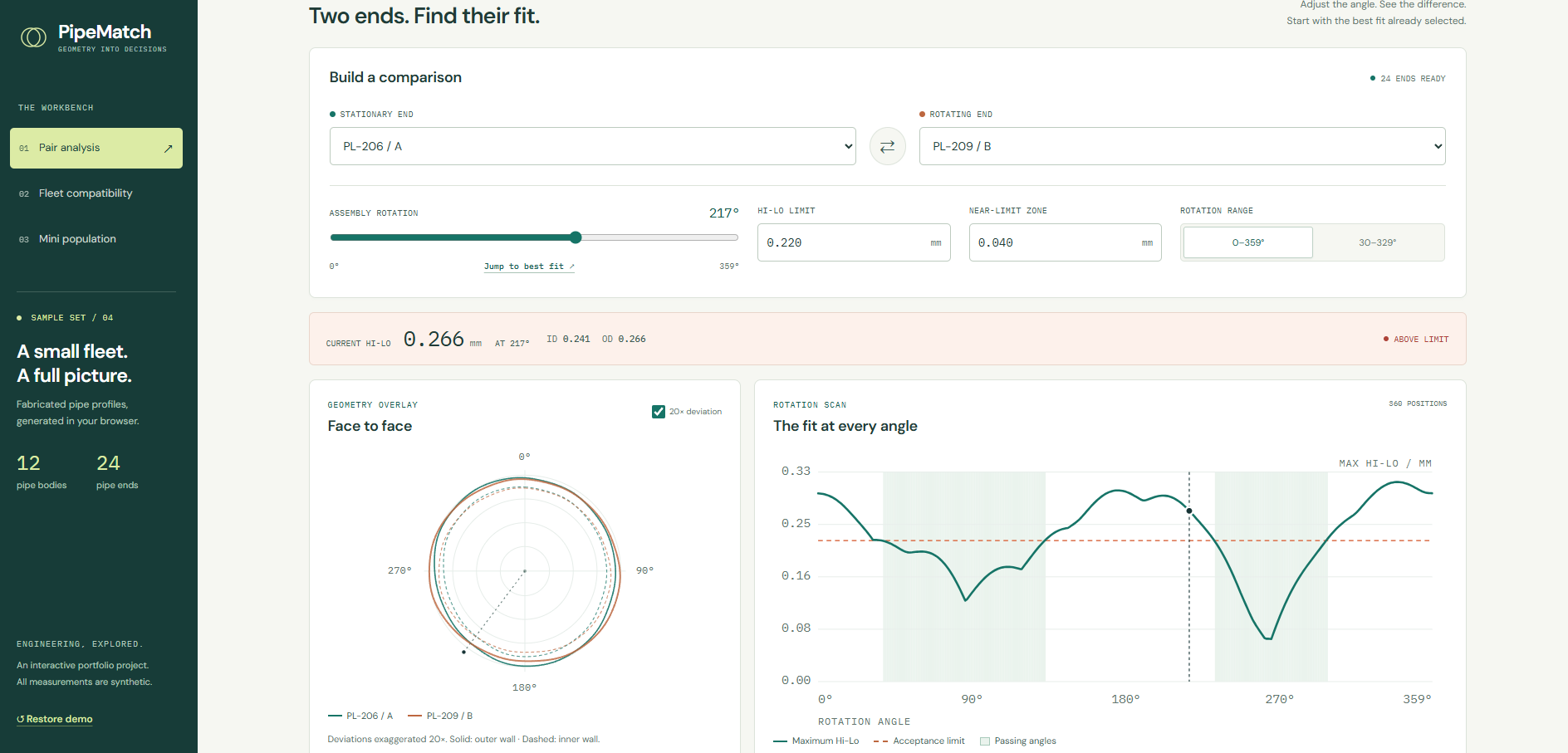
Pair analysis compares one stationary end with one rotating end. The face-to-face overlay draws both profiles with the deviations exaggerated 20 times, so the shape differences are visible. The rotation scan computes the hi-lo at every degree and plots it against the limit. Instead of guessing, the user can jump straight to the best-fitting angle, or drag the rotation and watch the inner and outer offsets change.
From one joint to a fleet
A single pair is only part of the problem. In practice, the question is which ends should be welded together at all. Fleet compatibility checks every eligible pairing in a set. For the 24 sample ends that is 264 pairings, because two ends of the same pipe body are never paired.
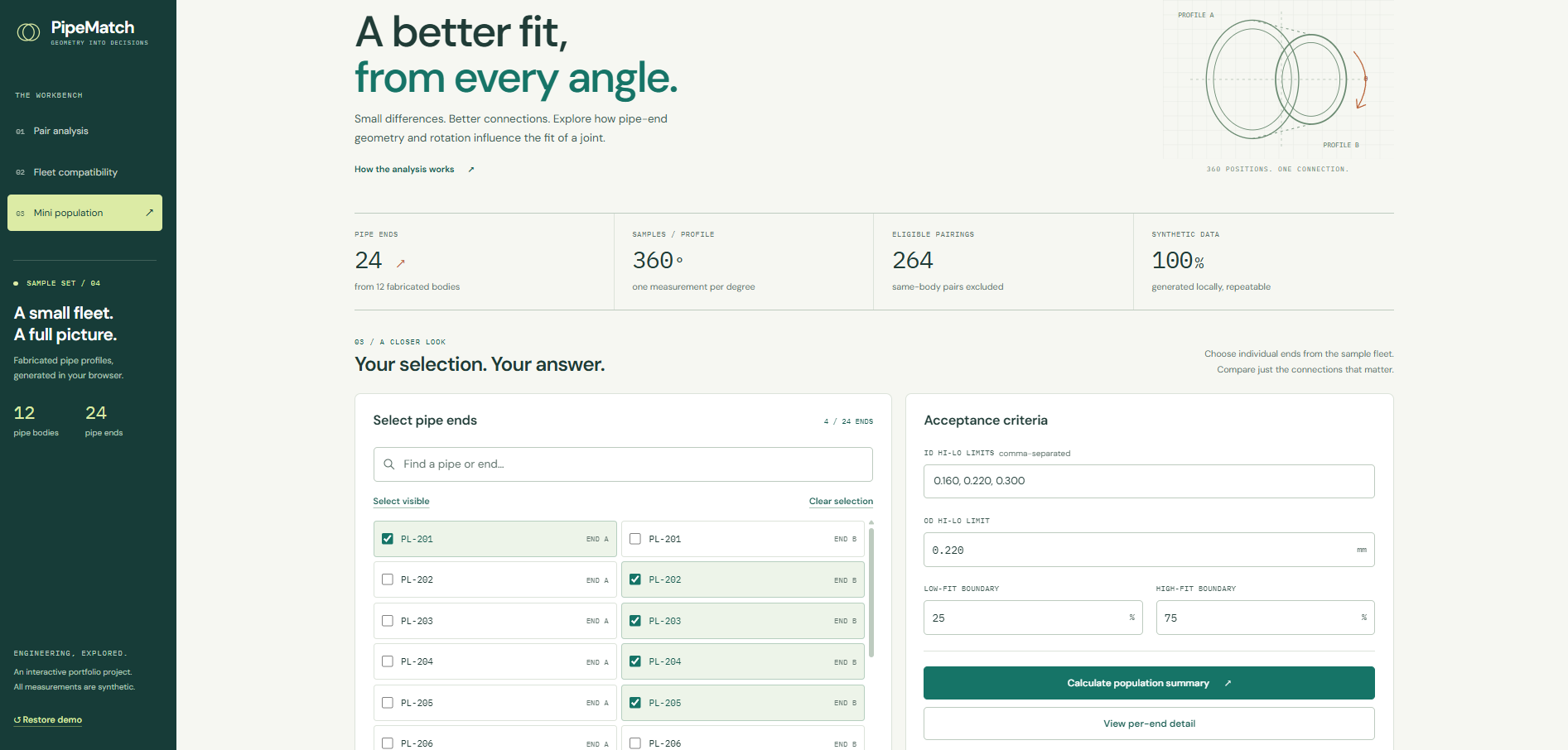
Mini population narrows this down to a chosen subset of ends. The acceptance criteria can include several ID hi-lo limits at once, an OD limit, and low-fit and high-fit boundaries. The result is a population summary and a per-end breakdown, so a limit can be compared across the same set of pipes before it is applied.